
Work Values vs Personality Types: What Actually Predicts Whether You'll Be Satisfied in a Role
Published 06 Jul, 2026Last updated 25 Sep, 2026
Mia scored high on conscientiousness and openness on her onboarding personality assessment, which was more or less the exact profile her firm was hiring for. Eighteen months later she was updating her resume on her lunch break. Nothing about the job had changed. The role rewarded speed and constant context-switching, and Mia needed depth: enough time with one hard problem to actually solve it before the next fire started. Her personality test had told her something true about who she is. It never asked the question that would have told her whether this particular job would let her live that way.
Career advice tends to split into two well-worn tracks. Find work that fits your personality. Find work that uses your strengths. Both have a real body of research behind them, and neither one explains what happened to Mia. There’s a third factor sitting underneath both, and it gets far less attention than it deserves: the match between what you need a role to give you and what that role is actually built to deliver. Researchers call the broader version of this person-environment fit. The part of it that matters most for a career decision comes down to work values: the specific things you need from a job to feel satisfied in it, measured against a real role, not who you are in general.
The Research on Personality and Job Satisfaction
The Big Five model measures five traits: conscientiousness, extraversion, agreeableness, openness, and neuroticism. It’s a solid, well-validated framework, and it does correlate with job satisfaction. Conscientious people tend to build habits that produce steady wins, and extraverts often draw energy from workplace interaction that introverts have to manage more deliberately. Those patterns show up again and again across the literature.
Where the story gets more interesting is the size of the effect. Furnham and colleagues ran two studies on real job applicants and employees in 2002 and found something researchers hadn’t expected going in: personality traits explained only a small share of what people said mattered to them at work, and a similarly modest share of their actual satisfaction levels once they were in the job. That’s not nothing. It’s also nowhere near a reliable predictor. Studies using the fuller Big Five framework have sometimes found larger effects. One 2024 study of 268 teachers at Punjab University found extraversion alone explained around 15 percent of the variance in job satisfaction, alongside a comparable link to career success. Even at that higher end, personality is answering something like a sixth of the question, at best.
There’s a structural reason this ceiling exists. Personality is comparatively stable across a career. The role in front of you isn’t, and neither is what you personally need from it. What made a fast-paced start-up feel exciting at twenty-six can feel unsustainable at thirty-four with a mortgage and a toddler who doesn’t sleep. A personality-based approach treats you as the variable that needs explaining. Job satisfaction was never a property of you alone, though. It’s a property of the relationship between you and the specific conditions of a specific job.
The Research on Work Values and Satisfaction
Work values sit closer to the ground. Instead of asking who you are, they ask what you need the role to deliver: control over your own decisions, feedback you can actually use, the sense that you’re getting better at something, colleagues you don’t have to manage your energy around. Because they’re more specific, they turn out to be more useful for predicting whether you’ll actually be satisfied.
Self-determination theory frames this around three basic psychological needs: autonomy, competence, and relatedness. A 2016 meta-analysis by Van den Broeck and colleagues drew together 99 studies and close to 120 samples, finding consistent links between satisfaction of these needs and workplace outcomes such as engagement and turnover intention. A 2026 meta-analysis covering 192 studies also found support for the proposed pathway from workplace need support, through need satisfaction and autonomous motivation, to workplace outcomes. The effects varied across work types and cultures, so neither finding can settle an individual career decision.
One study worth sitting with came from a very different setting. Miller, Mire, and Kim assessed 87 police officers on Big Five personality traits alongside job characteristics like autonomy and feedback quality. Not one personality trait significantly predicted job satisfaction. Personality accounted for roughly 9 percent of the variance overall, which the researchers themselves called fairly insignificant. What did predict it: the quality of feedback officers received, how much autonomy they had over their own decisions, and where they sat in their career, with the roughest patch landing around the ten-to-fifteen-year mark rather than at the start or the far end of a career. It’s one study of one profession. It shouldn’t be stretched further than that. But it lines up with the wider pattern: context and need satisfaction consistently outperform trait profiles.
Person-environment fit theory gives this a name. Job satisfaction isn’t about who you are or what the job is. It’s about how well the two fit together.
The Problem Both Approaches Share
Personality tests and work-values checklists share the same design flaw once you try to apply them to an actual career decision: both ask you to describe your preferences without ever forcing a choice between them.
Rate how important autonomy is to you. Now purpose. Now compensation, growth, recognition, stability. Most people rate almost all of it highly, because there’s no cost to saying yes to a checklist. Nobody loses anything by claiming they value flexibility and structure, impact and security, growth and work-life balance, all at once.
The list comes back looking like a wish, not a decision.
Real jobs don’t work that way. The role in front of you might offer excellent autonomy and mediocre pay. Genuine purpose and real instability. Strong mentorship and a brutal commute. The question that actually determines whether you take it, or whether you’re still there in three years, was never “what do you value?” It’s “what would you actually protect, once you can’t have all of it?”

The Trade-Off Layer: What’s Missing From Both Frameworks
Call this the trade-off pattern, and it sits underneath both personality and stated values. Knowing your values tells you what matters to you in the abstract. Looking at how you rate the conditions that shape a role can show where the practical picture differs.
Someone who ranks purpose as their top value on a survey might still find that autonomy is just as important when they rate the conditions of a role separately. That does not mean they lied about caring about purpose. It means a list of values alone may not show the full pattern behind a real career decision. Seeing that pattern is more useful than a list of things you approve of in principle.
This is the layer Kanso is built around. It asks you to rate workplace conditions one at a time, then shows the pattern in those ratings. It won’t tell you who you are, and it won’t tell you whether you’ll perform well in a given role. What it gives you is a clearer read on the conditions most likely to matter when a real job forces the issue, which is closer to the decision you’re actually trying to make.
Where This Leaves You
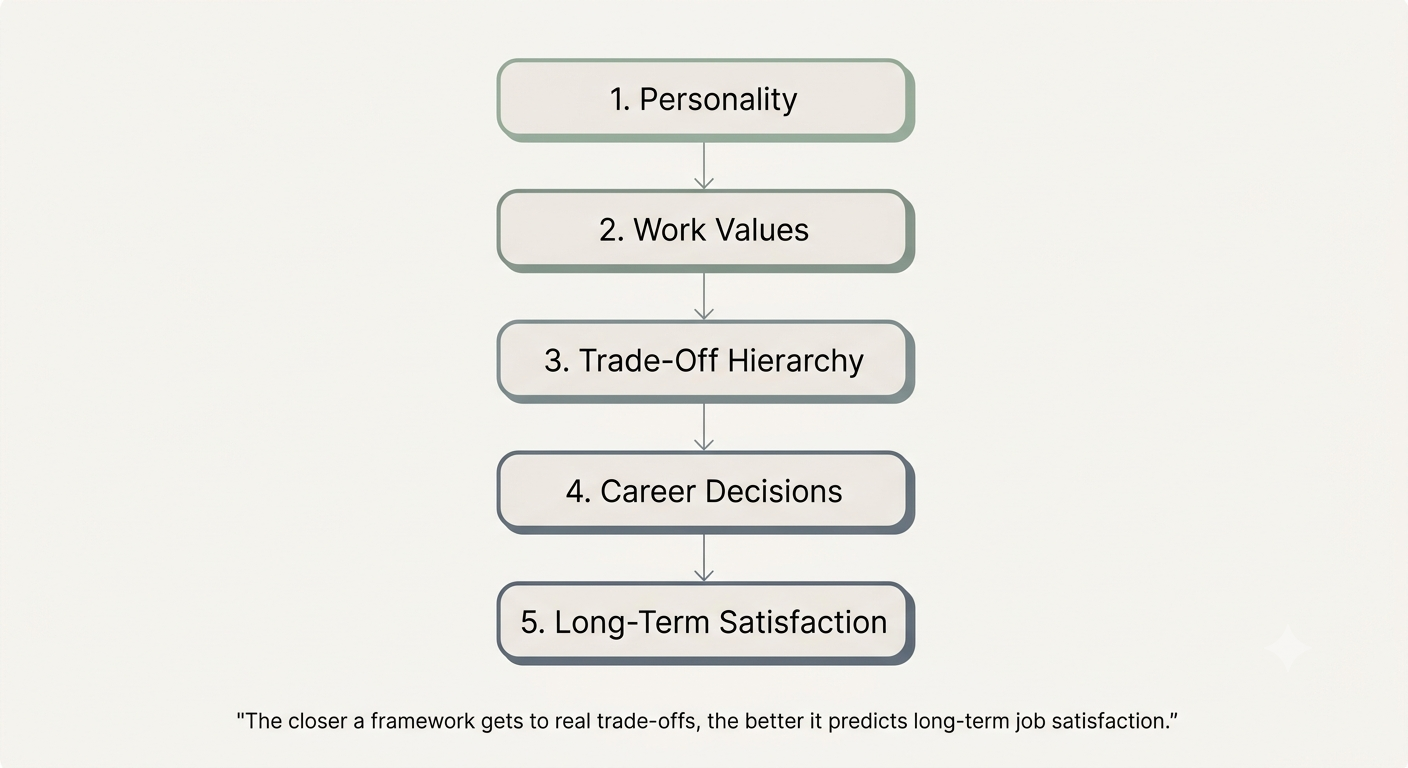
Personality type tells you who you are. Work values tell you what you say you want. The trade-off layer tells you what you’d actually protect when you can’t have everything, and that third layer maps most directly onto whether you’ll still like this job in eighteen months.
None of this makes the other two irrelevant. Your Big Five profile still helps you explain how you work to a manager or a team. Naming your values still gives you language for what you’re looking for in the first place. But if you’re trying to work out why a role that looked right on paper doesn’t feel right in practice, the trade-off layer is usually where the real answer is sitting, not in another personality report.
The free assessment takes about five minutes and maps that hierarchy directly: profile.trykanso.app. If autonomy specifically is the piece you suspect is off, Am I in the Right Job? goes further into what happens when a role’s actual level of autonomy doesn’t match what you need from it.
References
Furnham, A., Petrides, K.V., Jackson, C.J., & Cotter, T. (2002). Do personality factors predict job satisfaction? Personality and Individual Differences, 33(8), 1325-1342.
Mufti, A.A. (2024). Investigating the link between specific personality characteristics, such as conscientiousness and extraversion, and career achievements and job satisfaction. The Critical Review of Social Sciences Studies, 2(2).
Miller, H.A., Mire, S., & Kim, B. (2016). Predictors of job satisfaction among police officers: Does personality matter? Journal of Criminal Justice, 37(5), 419-426.
Van den Broeck, A., Ferris, D.L., Chang, C.H., & Rosen, C.C. (2016). A review of self-determination theory’s basic psychological needs at work. Journal of Management, 42(5), 1195-1229.
Hagger, M.S., & McAnally Star, K. (2026). Self-determination theory and workplace outcomes: A meta-analysis. Stress and Health, 42, e70151. https://doi.org/10.1002/smi.70151