
What Your Team Members Would Actually Trade - And Why You Should Know Before They Quit
Published 28 May, 2026Last updated 25 Sep, 2026
There’s a conversation most managers only have in retrospect.
Someone good - someone you relied on, someone you thought was fine - submits their resignation. And when you sit down for the exit interview, you hear something that floors you: they wanted more autonomy. Or felt their work had stopped mattering. Or had been quietly burning out for eight months while hitting every metric you tracked.
You thought you knew them. You checked in. You gave good feedback. You had an engaged, high-performing team, and then one of them left - and the reasons didn’t match anything you’d been measuring.
This isn’t a management failure, exactly. It’s a signal problem.
People Don’t Leave Companies. They Leave Misaligned Roles.
The old saying - “people don’t leave companies, they leave managers” - has some truth to it, but it misses the deeper pattern. What the data consistently shows is that people leave misalignment. They leave situations where what they most need from work has quietly drifted out of reach, often without anyone noticing, including themselves.
The evidence on this is striking. Gallup research finds that issues related to engagement and culture, along with well-being and work-life balance, together account for 69% of the reasons employees leave - far outweighing pay or benefits concerns. And yet, in most organisations, retention strategy is still anchored to compensation benchmarking and annual engagement scores.
The iHire 2025 Talent Retention Report found that over a quarter of employees who left their jobs in 2025 cited a toxic or negative work environment, followed by nearly a quarter who departed due to poor company leadership, and over a fifth who quit because of dissatisfaction with their direct manager. These aren’t abstract “culture” problems. They’re signals about alignment - between what a person needs and what their day-to-day experience actually delivers.
The cost of getting this wrong is significant. Replacing leaders and managers can cost about 200% of their salary, while technical roles average 80% and frontline employees 40%, according to Gallup. Multiply that across a team of ten over two years, and retention isn’t a people problem - it’s a P&L problem.
What Most Managers Don’t Actually Know About Their Team
Here’s the uncomfortable gap: most managers believe they have a solid read on what motivates their team. The data suggests otherwise.
A 2026 Skills Visibility Report by TalentLMS found that 90% of managers say they have a good understanding of their direct reports’ skills and needs - but only 69% of employees agree. Similarly, 75% of managers believe their team’s skills are fully utilised, while 49% of employees say their company underutilises their skills.
That 21-point perception gap isn’t just about skills. It reflects a broader pattern: managers work with the information they can observe - output, attendance, performance metrics - while the things that actually drive someone’s decision to stay or leave are often invisible. What someone values. Whether their work still feels meaningful. How they’d trade one thing for another if forced to choose.

Gallup research on manager blind spots found that nearly 60% of managers feel they are doing a good job recognising their team’s hard work, but only about a third of individual contributors (35%) share the same view. The biggest gaps between manager and employee perceptions show up specifically around recognition and feedback - two of the factors most tightly linked to whether people stay.
Research from ADP found that when a team leader is fully engaged, 65% of their team members are also fully engaged - compared to less than 1% of team members when the team leader is not fully engaged. But engagement isn’t a lever a manager can pull directly. It emerges from the daily experience of feeling seen, valued, and doing work that actually fits who you are.
Why Surveys Won’t Save You: Stated vs. Revealed Values
Annual engagement surveys have become a fixture of corporate life. They’re well-intentioned, widely deployed, and largely insufficient.
The core problem is a concept that economists call the stated preference vs. revealed preference gap. Revealed preference theory - pioneered by economist Paul Samuelson in 1938 - holds that you can’t reliably understand what people truly value by asking them directly. People’s real preferences are revealed through their choices and behaviour, not through self-report. There is often a stark contrast between stated intentions and actual actions.
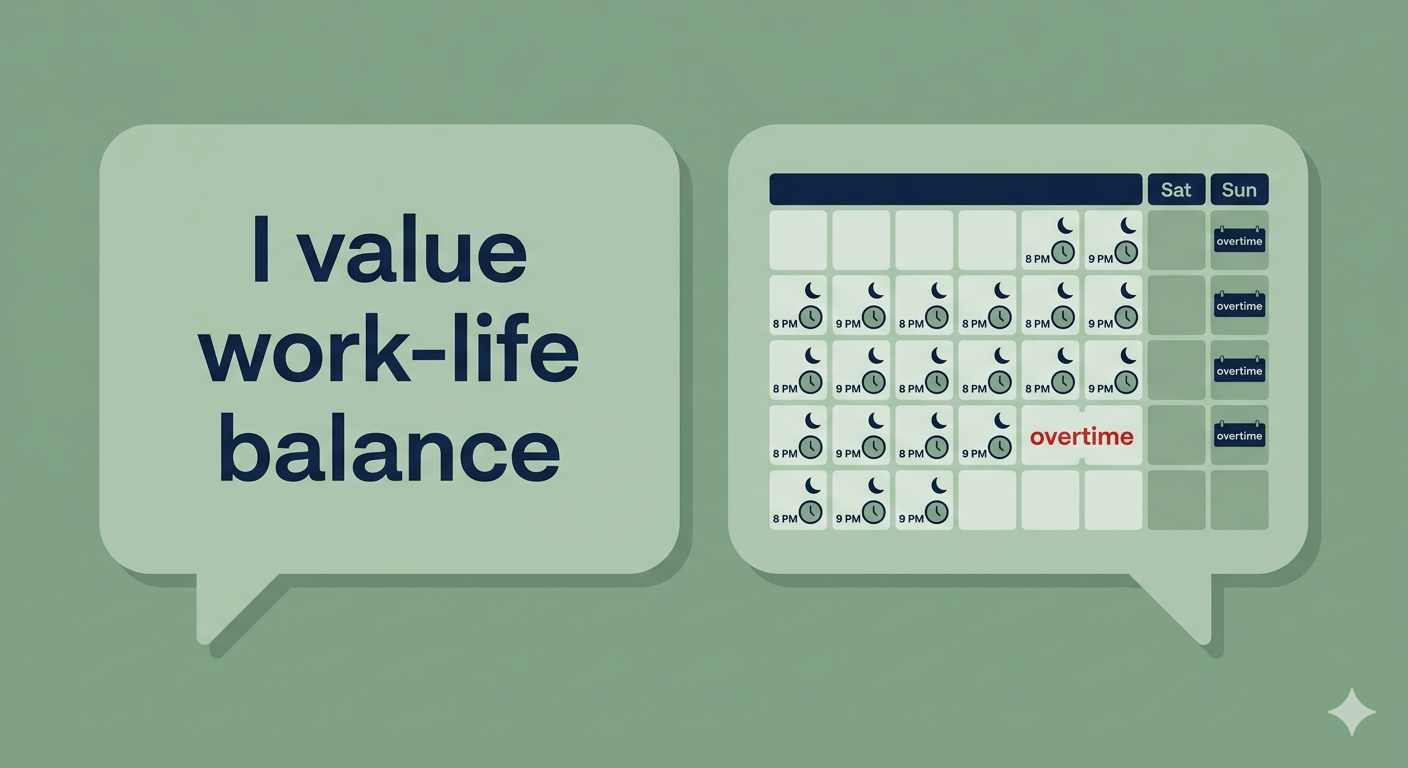
The mismatch is common: what people say they value and what their work pattern reveals can diverge under pressure.
In practice, this gap shows up everywhere. When offered overtime or promotions that require longer hours, many employees accept - even those who say work-life balance is their top priority. Their revealed preference is for financial incentives or career progression, even if that’s not what they’d say in a survey.
The survey problem compounds this. Research from Visier found that nearly half (47%) of employees say they sometimes feel pressured to withhold honest feedback when completing engagement surveys. One in four employees injects inaccurate or incomplete information into their organisation’s decision-making processes. Other research puts this even higher, with 50% of employees reporting they are less than fully truthful in survey feedback - often because they fear professional repercussions for saying something negative about their team, boss, or work experience.
So you have a tool that measures what people say they value, completed by people who are often not being fully honest, producing results that may not reflect what people would actually choose when forced to trade one thing for another. And then decisions about retention strategy get built on top of that. Standard personality types like MBTI have the same blind spot - they describe who you are, not what you’d actually trade. See why Kanso goes beyond MBTI.
Employee engagement surveys were widely treated as a reliable proxy for flight risk - the likelihood that a valued employee would leave. But they abjectly failed to predict the Great Resignation. Attrition became a major issue even in companies with relatively high engagement scores.
The question isn’t whether to listen to your team. It’s whether you’re listening in the right way.
The Power of Knowing What People Would Actually Trade
There’s a better signal than survey responses: trade-off behaviour.
When someone reveals what they’d be willing to give up to get something else, you learn something real about their values hierarchy. Not what they think they should want. Not what sounds good. What actually matters to them when the stakes are real.
This is the principle behind conjoint analysis, used in marketing research for decades. You don’t ask customers “how important is price to you?” - you give them real product configurations and see which they choose. The choices reveal the weights.
Applied to work values, the same logic holds. If you ask someone “what do you value at work?” they’ll tell you what’s socially acceptable: meaningful work, growth, good team culture. But if you ask them to trade - would you give up some autonomy for significantly better pay? Would you accept a harder role for more recognition? Would you take a lateral move to work on something that actually excites you? - the answers get real quickly.
This is also why tracking how someone’s values shift over time is more useful than any single snapshot. Values at work aren’t fixed. Someone who joined your team hungry for growth might, two years later, be prioritising stability. Someone who started with strong social needs might be craving solitude and deep focus. The thing that makes them feel valued changes.
Instead of asking what would motivate someone, you can examine what has actually motivated them. What got prioritised when resources were tight? What energised them versus what drained them? That evidence trail reflects real decision criteria - not the ones people think they use, but the ones that actually drive behaviour.
What Longitudinal Values Tracking Tells You About Flight Risk
The most useful signal isn’t what someone values today. It’s the direction of drift - whether what they’re getting from their role is moving toward or away from what they actually need.
Flight risk almost never appears suddenly. It builds over months. Someone’s need for creative challenge starts going unmet. Their sense of purpose in the work quietly erodes. They start optimising for the exit without consciously deciding to. By the time they’re actively job-searching, the internal decision was made six months ago.
Traditional retention metrics - eNPS scores, engagement survey results, performance data - are mostly lagging indicators. They tell you what already happened. What managers need are leading indicators: early signals that someone’s values and their current role are diverging.
This is where consistent, structured values tracking becomes a practical tool rather than a philosophical exercise. If you know that a team member’s sense of autonomy has been declining for three months, you can have a specific conversation before it becomes a resignation. If you can see that someone’s connection to meaning in their work has dropped, you can explore whether their role has drifted from what energised them when they joined.
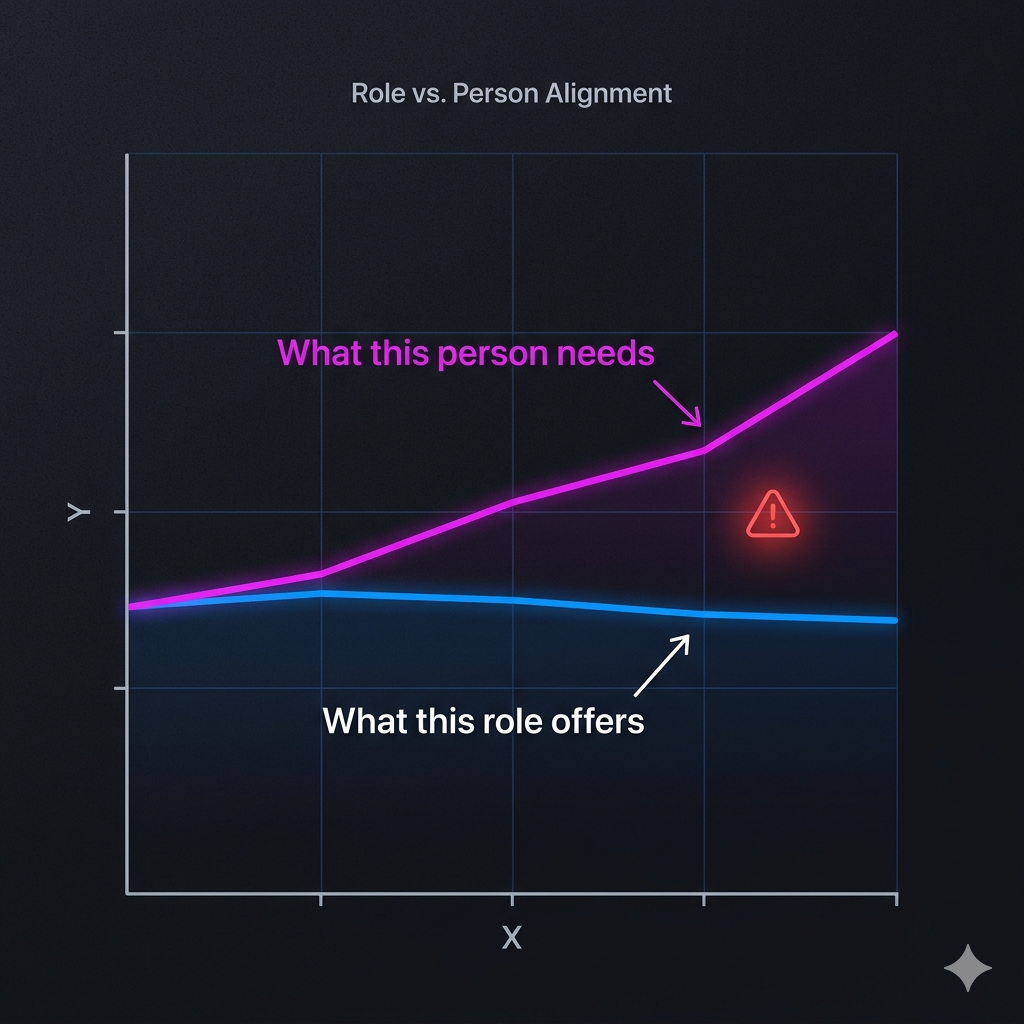
You cannot close a gap you do not know is there. In a market where strong performers have real options, that blind spot is costly.
The conversation is much easier when it’s proactive. “I noticed this role has shifted toward a lot more coordination work - is that fitting with what you’re looking for?” lands very differently from an exit interview.
How to Start This Conversation With Your Team
The practical challenge is that most managers don’t have a structured way to understand what their team members actually value - and even fewer have a way to track how those values evolve.
Here are some starting points that work better than standard check-ins:
Ask about trade-offs, not satisfaction. Instead of “how are you finding your workload?” try “if you could change one thing about how your role is structured, what would it be - even if it meant giving up something else?” The second version forces a real answer. The first invites reassurance.
Watch for energy, not just output. Performance metrics measure what gets done. They don’t measure how someone feels doing it. Pay attention to where energy spikes - what kinds of problems a person leans into vs. what they power through with visible effort. That contrast reveals more than any survey.
Make values an explicit topic, not a subtext. Many managers feel awkward having direct conversations about what someone needs from their work. But most people find it a relief to be asked directly, especially if it’s framed as “helping me understand how to make this role work well for you” rather than “I’m trying to figure out if you’re a flight risk.”
Revisit periodically. Someone’s values in their first year on a team are not the same as their values in year three. Life changes. Priorities shift. A check-in that worked 18 months ago may be based on a completely outdated picture of what matters to them.
Create safety for honest answers. Engagement isn’t a fixed score - it’s a condition that employers create when they understand and act on what employees need. Collecting feedback without follow-up is worse than not asking at all. If your team has learned that raising concerns leads to nothing, they’ll stop raising them.
The Manager’s Advantage
There’s something worth naming here: the direct manager is the only person in an organisation with both the relationship and the access to do this well.
HR can run surveys. Leadership can set culture. But the person who has regular 1:1s with your team members, who knows their context, who can notice the shift in energy - that’s you.
Gallup’s recent research found that US employee engagement hit a 10-year low of 31% in 2024, a stagnation that is estimated to be costing the economy roughly $2 trillion in lost productivity. That number is a collective result of millions of individual manager-employee relationships where the values mismatch was never caught early enough.
The good news is that the window to catch it is usually long. Misalignment builds slowly. A manager who genuinely understands what their team members value - not in the abstract, but specifically, and tracked over time - has a meaningful retention advantage that compensation packages alone can’t replicate.
A Tool Built for This
Understanding what your team members actually value - and how that changes over time - is exactly what Kanso is designed to surface.
Kanso goes beyond stated preferences to reveal revealed trade-offs: what people would actually choose when they can’t have everything. Over time, it tracks how those priorities shift, giving managers a leading indicator of alignment rather than a lagging measure of dissatisfaction.
Values don’t announce themselves before they drive a resignation. But they do leave signals - if you know how to read them.